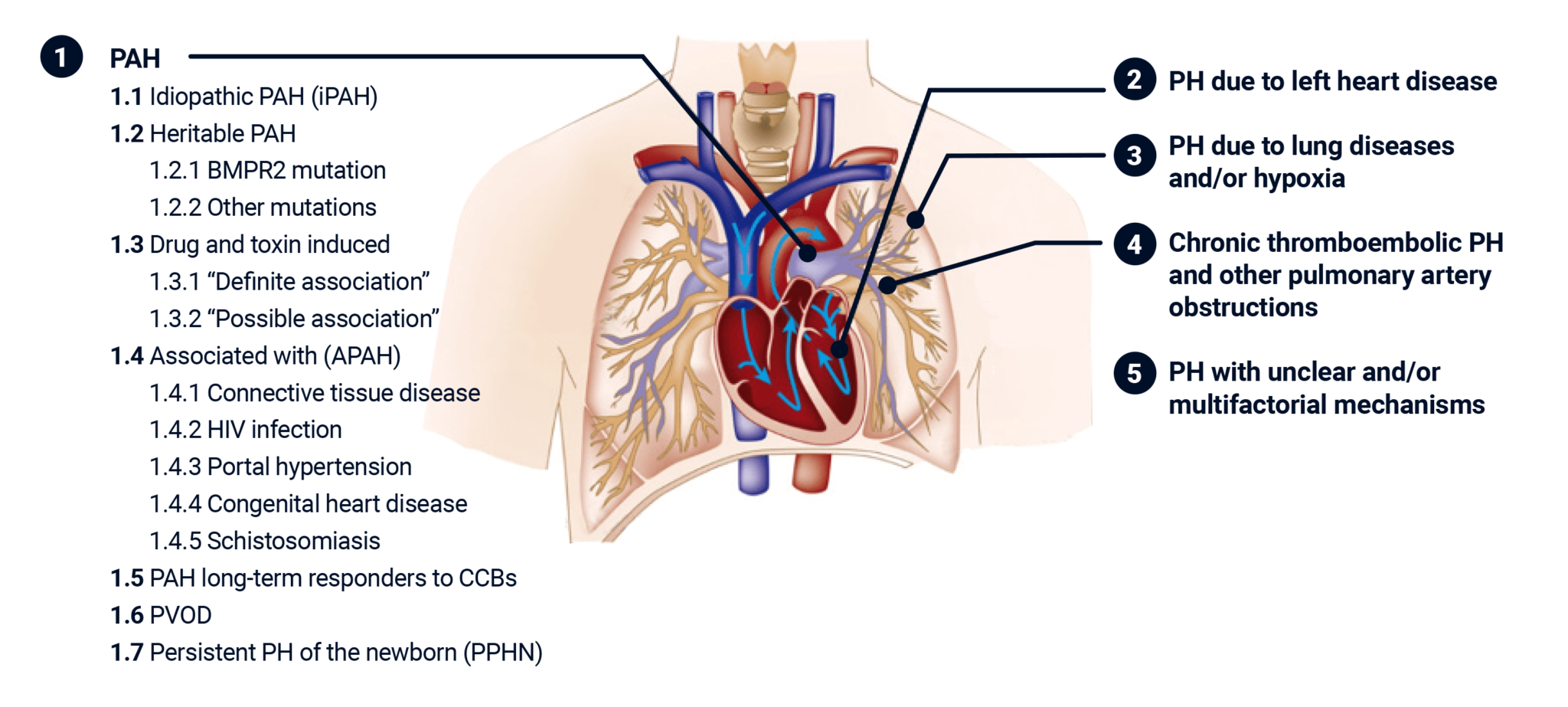
Pulmonary hypertension (PH) is a pathophysiological disorder characterised by elevated blood pressure in the pulmonary arteries.1 It is categorised into five main groups according to clinical presentation, pathological findings, haemodynamic characteristics and treatment strategy:1,2
Clinical classifications of pulmonary hypertension
Adapted from Galiè N, et al. 2016, and Simonneau G, et al. 2019.1,2
Group 1: PAH
PAH is further sub-divided into groups based on understanding of the underlying disease mechanisms:1,2
iPAH – PAH with unknown cause (idiopathic); accounts for between 35% and 48% of all cases of PAH3
HPAH – often due to a specific mutation on the BMPR2 gene, but sometimes due to other mutations; accounts for approximately 6–10% of cases of PAH4
Drug- or toxin-induced PAH – may develop as a rare side effect of certain illicit drugs and toxins, such as methamphetamines, some prescription diet pills (e.g. Aminorex, Redux), and some chemotherapy agents1
Associated PAH – PAH associated with other conditions, most commonly connective tissue disease (especially systemic sclerosis – click here for more information), congenital heart disease, HIV infection, portal hypertension, as well as other less common conditions
References
Galiè N, et al. Eur Heart J 2016; 37:67–119.
Simonneau G, et al. Eur Respir J 2019; 53(1):1801913
McGoon MD, et al. J Am Coll Cardiol 2013; 62(25 Suppl):D51-5.
McLaughlin VV, et al. J Am Coll Cadiol 2009; 53:1573–619.
This content is intended for Australian healthcare professionals. For more information on pulmonary hypertension, please contact your healthcare professional.
The information a reader is about to be referred to may not comply with the Australian regulatory requirements. Further information relevant to the Australian environment is available from the Company or via the Product Information.
World Health Organization functional class (WHO-FC) for patients with PH3,5
This system grades PH severity according to the patient’s functional status, by linking symptoms with activity limitations. WHO-FC remains a powerful predictor of outcomes in patients with PAH.
WHO - FC
Description
I
Patients with PH in whom there is no limitation of usual physical activity; ordinary physical activity does not cause increased dyspnoea, fatigue, chest pain, or presyncope.
II
Patients with PH who have mild limitation of physical activity. There is no discomfort at rest, but normal physical activity causes increased dyspnoea, fatigue, chest pain, or presyncope.
III
Patients with PH who have a marked limitation of physical activity. There is no discomfort at rest, but less than ordinary activity causes increased dyspnoea, fatigue, chest pain, or presyncope.
IV
Patients with PH who are unable to perform any physical activity at rest and who may have signs of right ventricular failure. Dyspnoea and/or fatigue may be present at rest, and symptoms are increased by almost any physical activity.
Adapted from McGoon M, et al. 2004.5
Leaving website
The information a reader is about to be referred to may not comply with the Australian regulatory requirements. Further information relevant to the Australian environment is available from the Company or via the Product Information.
The information a reader is about to be referred to may not comply with the Australian regulatory requirements. Further information relevant to the Australian environment is available from the Company or via the Product Information.
The information a reader is about to be referred to may not comply with the Australian regulatory requirements. Further information relevant to the Australian environment is available from the Company or via the Product Information.
The information a reader is about to be referred to may not comply with the Australian regulatory requirements. Further information relevant to the Australian environment is available from the Company or via the Product Information.
The information a reader is about to be referred to may not comply with the Australian regulatory requirements. Further information relevant to the Australian environment is available from the Company or via the Product Information.
The information a reader is about to be referred to may not comply with the Australian regulatory requirements. Further information relevant to the Australian environment is available from the Company or via the Product Information.
The information a reader is about to be referred to may not comply with the Australian regulatory requirements. Further information relevant to the Australian environment is available from the Company or via the Product Information.
The information a reader is about to be referred to may not comply with the Australian regulatory requirements. Further information relevant to the Australian environment is available from the Company or via the Product Information.
The information a reader is about to be referred to may not comply with the Australian regulatory requirements. Further information relevant to the Australian environment is available from the Company or via the Product Information.
The information a reader is about to be referred to may not comply with the Australian regulatory requirements. Further information relevant to the Australian environment is available from the Company or via the Product Information.
The information a reader is about to be referred to may not comply with the Australian regulatory requirements. Further information relevant to the Australian environment is available from the Company or via the Product Information.